




For years, SaaS companies sold a simple promise: pay only for what you use. But somewhere along the way, that promise quietly changed.
Today, many small businesses signing up for tools like monday.com discover something frustrating only after reaching checkout:
You are not paying for your team size.
You are paying for the minimum team size the vendor wants you to have.
That pricing structure has earned a nickname among founders and operations teams: The Ghost Seat Tax.
The “Ghost Seat” tax refers to mandatory software seats that companies are forced to buy even when nobody uses them.
Example:
This may sound small at first. But multiplied across tools, departments, and annual renewals, the waste compounds fast.
According to research from Vertice, 66% of SaaS licenses are either unused or underutilized across organizations.
Another report found that enterprises waste 30–40% of SaaS licenses due to inactive or unnecessary seats.
That means the “ghost seat” problem is not just annoying pricing psychology. It has become a measurable operational cost.
Monday.com doesn't sell licenses one at a time. It sells them in fixed buckets, and the rules come straight from their own support docs: pricing plans start at a minimum of 3 seats, and then ascend in multiples of 5.
If you have a team of 4, you choose the 5-seat option. A team of 6 has to select the 10-seat plan.
In other words:
As one independent pricing analysis put it bluntly: this "ghost seat" tax is the single most criticized aspect of Monday's pricing — and it is not obvious until you reach the checkout page.
The math is unforgiving. A 6-person team on the Standard plan ($12/seat/month, annual) doesn't pay $72/month — they pay $120/month, for four seats no one will ever log into. Over a year, that's $576 spent on ghost seats.
Monday.com has never publicly explained the bucket model. The practical effect, however, is well documented: most teams pay for more seats than they use, increasing average revenue per account.

Per-seat pricing is standard in SaaS. Seat buckets are not. Competitors like Asana, ClickUp, and Linear all use per-user pricing without buckets. You pay for what you use.
Monday's bucket model is closer to how telecoms used to sell minutes: rounded up, billed monthly, easy to forget. The difference is that nobody in 2026 thinks rounding up phone minutes is a fair deal.
There are two moments where the ghost seat tax bites hardest:
Solopreneurs and 2-person teams pay for 3 seats from day one — a 50–200% premium before they've shipped a single project.
Hiring your 11th person? Your bill jumps from 10 seats to 15. You'll pay for four empty chairs until you backfill them.
Ghost seats are not just a Monday.com problem — they reflect a much larger SaaS waste crisis.
Industry reports estimate that companies waste 30–50% of SaaS spending on unused licenses, duplicate tools, and inactive subscriptions.
At the same time, global SaaS spending continues to rise into the hundreds of billions annually, according to Gartner.
Most SaaS waste happens accidentally through poor license management. But when pricing models force customers to pay for seats they never needed, the waste is built into the contract itself.
That’s the ghost seat tax.
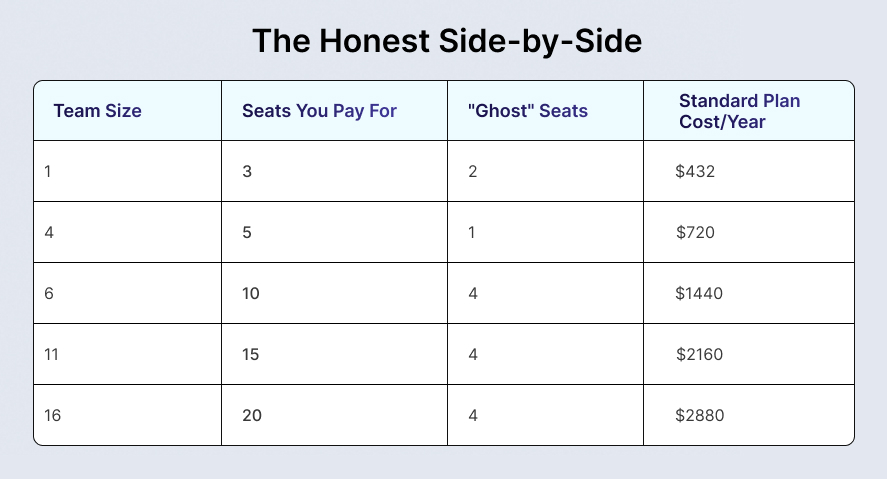
Based on Monday.com Standard plan at $12/seat/month, billed annually
At every common team size, you're paying for a meaningful slice of seats that nobody is using. And because most SaaS contracts auto-renew with annual price uplifts, the cost of those ghost seats compounds quietly, year after year.
Kroolo was built on a simple premise: in 2026, teams aren't static. They scale up and down, work with freelancers, and bring in cross-functional partners only when needed. Pricing should bend to that reality — not the other way around.
Here's how Kroolo's pricing is structured differently:
Kroolo's paid plans charge for the exact number of users you have — Plus at $25/user/month (20% off with annual billing) and Business at $35/user/month. A team of 1 pays for 1. A team of 6 pays for 6. A team of 11 pays for 11. There is no "round up to the next bucket" math, and no 3-seat floor that solopreneurs have to clear before they get to actually use the product.
Monday's Free plan caps you at 2 seats and 3 boards, with zero automations and zero integrations — it's a demo tier. Kroolo's Starter plan is free forever and includes:
For a 5-person startup, that's the difference between $720/year on Monday Standard (5-seat bucket × $12 × 12) and $0 on Kroolo Starter. The free plan is a working tier, not a trial.
Most teams on Monday.com also pay for Slack (or Teams) for messaging, Notion or Confluence for docs, and a separate AI tool on top. That's three to five subscriptions before they've managed a single project. Kroolo bundles Projects, Tasks, Goals, Docs, Channels, AI Agents, and Enterprise Search into a single workspace — replacing tools like Asana, Notion, Slack, Jira, Trello, and ClickUp at once. One bill. One login. No integration tax.
Most legacy tools sell AI as a separate add-on or per-credit consumption tier. Kroolo includes Generative AI in every plan — including the free Starter tier. Project generation, chat-with-docs, sprint planning, and AI agents all work out of the box. You're not paying a separate "AI Sidekick" line item on top of your seats.
Kroolo's Business and Enterprise plans ship with SOC 2 compliance, GDPR compliance, and AES-256 encryption by default. Enterprise adds SSO, SCIM provisioning, custom roles, and regional data residency across US, EU, and APAC — paired with a dedicated CSM and live onboarding. AI agents run inside a Private Vector Sandbox that respects internal workspace permissions, so proprietary data stays inside the tenant.
| Team Size | Monday.com Standard (annual) | Kroolo |
|---|---|---|
| 1 | $432/year (3-seat min) | Free (Starter) |
| 3 | $432/year | Free (Starter) |
| 5 | $720/year (5-seat bucket) | Free (Starter) |
| 6 | $1,440/year (10-seat bucket) | $1,440/year (Plus, annual) — 0 ghost seats, includes docs/chat/AI |
| 11 | $2,160/year (15-seat bucket) | $2,640/year (Plus, annual) — 0 ghost seats, no tool sprawl |
Kroolo Plus shown at $20/user/month with 20% annual discount. Monday.com Standard at $12/user/month, billed annually.
If you're evaluating project management tools right now, three questions cut through the marketing:
On all three, Kroolo passes. Monday.com doesn't
Conclusion
Monday.com is a capable product. The bucket pricing model isn't malicious — it's just optimized for the vendor, not the customer. But when 25 cents of every SaaS dollar is already being lost to license waste, the last thing you need is a vendor whose pricing structure guarantees more of it.
Before you sign that annual contract, do the math at your actual team size. Then do it again at the size you'll be after hiring next quarter. If the numbers feel off, that's not a sticker-shock illusion.
That's the ghost seat tax.
Sign up with Kroolo for FREE and let's get started.